
The Real Estate Industry has a problem!
And no… it’s not about the NAR lawsuits. It’s a production problem. Most Agents Don’t Realize It Yet.
Here’s the stat that should make everyone uncomfortable.
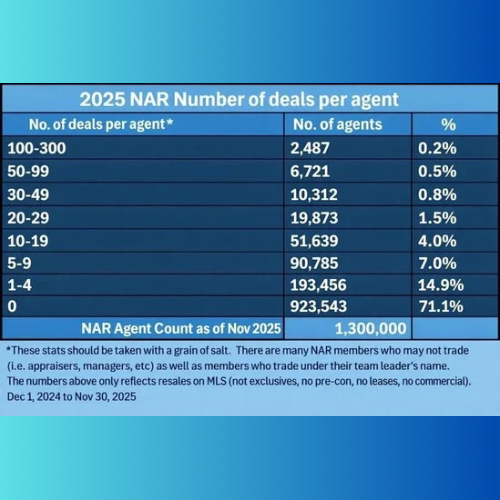
Out of roughly 1.3 million NAR members, more than 71 percent closed zero transactions in the last twelve months.
Think about that.
Another 15 percent closed between one and four deals.
About 7 percent closed five to nine.
Only roughly 7 percent of agents closed ten or more transactions all year.
And the group everyone talks about? The “top producers”? Agents closing 20+ deals annually represent less than 3 percent of the entire industry.
I spend my days talking to the agents in that top 7-10% range. The ones trending up. The ones outpacing their markets. And I can tell you exactly what separates them from the 71% doing nothing.
It’s not skill. It’s not motivation. It’s not even market conditions.
It’s leverage.
The Myth of Effort-Based Growth
I hear the same story from agents who are stuck.
Work harder. Post more. Call more. Buy leads. Chase the algorithm.
But effort without leverage just burns you out. It doesn’t create scale.
The agents doing 20, 30, 50+ transactions per year aren’t working 5x harder. They’re operating inside better systems. They’re buying leverage instead of renting attention.
And here’s what most people won’t tell you: they control their data while other agents are the data.
Why Marketing Spend Isn’t the issue
When I talk to agents about investing in their business, I get the same objections.
“I don’t want to waste money.”
“I don’t want to gamble on ads.”
“I tried Facebook once. It didn’t work.”
Those aren’t objections. They’re symptoms of working without infrastructure.
Most agents don’t actually have a marketing budget. They have random expenses.
A boosted post here. A Zillow lead there. A CRM they don’t fully use. A landing page that goes nowhere.
Money isn’t the problem. Direction is.
Top producers treat marketing the way a business treats its inventory. It’s an asset, not a gamble. They know exactly what they’re buying, why they’re buying it, and what data they’re extracting from it.
Owning Your Data Is the New Moat
If your business relies on platforms you don’t control, you don’t own a business. You’re renting distribution.
Most agents can’t answer basic questions about their own operation:
Where do my last 50 clients actually come from?
Which campaigns convert conversations, not just clicks?
Who in my database is active versus dormant?
What does my follow-up system actually do without me touching it?
When you don’t own your data, every market shift feels like a crisis.
When you do, volatility becomes opportunity.
Data ownership allows you to:
• Allocate spend intelligently instead of emotionally
• Build repeatable systems instead of one-off wins
• Scale relationships without losing personalization
• Step away without your pipeline collapsing
This is the quiet advantage top producers have. Not talent. Infrastructure.
Why Most Brokerages Make This Worse
Here’s where the industry compounds the problem.
Most brokerages are optimized for volume, not performance.
They provide tools, but not integration. They offer CRMs, but not strategy. They give access, but not ownership.
Agents are left stitching together systems that don’t talk to each other, chasing vanity metrics, and mistaking activity for progress.
The result is predictable. Burnout at the bottom. Chaos in the middle. And a small percentage quietly compounding at the top.
I’ve watched this play out for years. Talented agents stuck in systems designed to extract from them, not build with them.
Leverage Is the Only Way Out of the Middle
The data makes one thing clear.
You either build leverage into your business or you eventually stall.
Leverage comes from:
• Systems that work without constant input
• Marketing that feeds owned databases, not rented platforms
• Clean data that informs decisions instead of guessing
• Infrastructure that compounds year over year
This is why the jump from 5-9 deals to 20+ deals feels so wide. It’s not incremental growth. It’s a structural shift.
And once that shift happens, the gap widens fast.
The Question Every Agent Should Be Asking
The industry will continue to shrink at the bottom and concentrate at the top. That’s already happening.
So the real question isn’t whether the data is accurate. It’s whether your current model survives this distribution.
Are you building a business that compounds? Or are you relying on effort, luck, and the next market cycle?
I talk to agents every week who are crushing their numbers but feel like they’re barely keeping up. They’re producing at a high level but can’t figure out how to scale without working themselves to death.
That’s the gap nobody talks about. The difference between working in your business and owning the infrastructure that makes your business work.
Because the agents who take ownership over their marketing, their data, and their leverage aren’t just surviving this market.
They’re quietly positioning themselves to dominate the next one.